-
Goal of Contract
The Florida Department of Environmental Protection has contracted ESD Waste2Water, Inc., among other companies, to provide treatment to combat harmful algal blooms within Lake Okeechobee by reducing the amount of total phosphorus and total nitrogen in the water column.
-
Work to be Performed
ESD Waste2Water will utilize its Ferrate technology, an environmentally friendly water treatment chemical with a strong oxidation potential. Water will be pumped from the C-59 canal, treated, and returned to the canal.
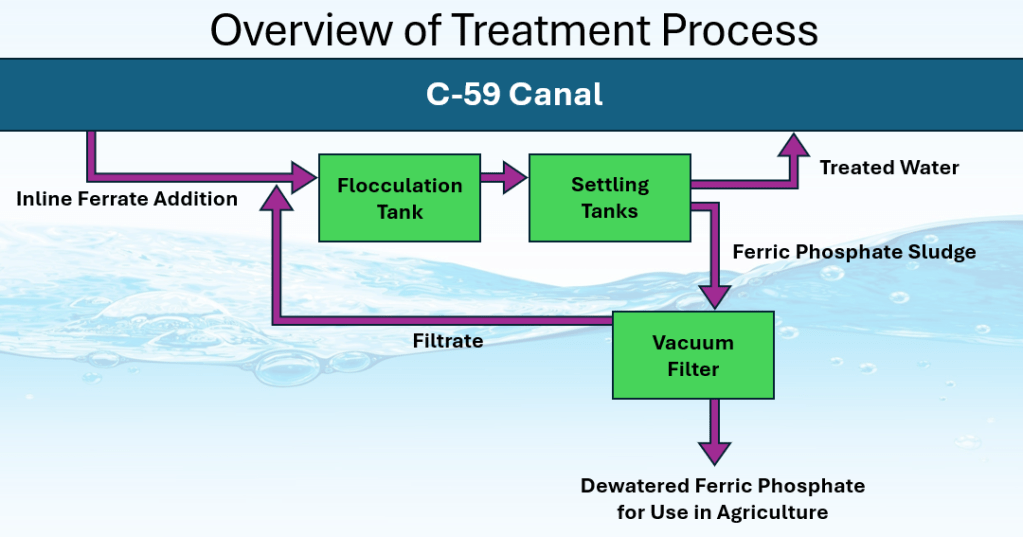
Treatment will begin with the inline addition of Ferrate followed by mixing within a flocculation tank. Reduced forms of nitrogen will be oxidized to nitrogen gas. As Ferrate oxidizes nitrogen, it will form a non-toxic coagulant that will co-precipitate phosphorus as ferric phosphate. The water will then flow into settling tanks, where treated water and precipitated solids will be separated. Treated water will be returned to the canal while ferric phosphate sludge will be dewatered by vacuum filtration. Filtrate will be returned to the beginning of the process, and the dewatered ferric phosphate will be used in agriculture as a soil amendment.
Nutrient removal will be quantified by measuring the concentration of total phosphorus and total nitrogen at the influent and effluent of the treatment system, as well as the flowrate of water through the system.
The initial treatment flowrate will be 1,000 GPM. The system will have the capability to increase the flowrate to meet the goals of the department.
-
Location of Work Area
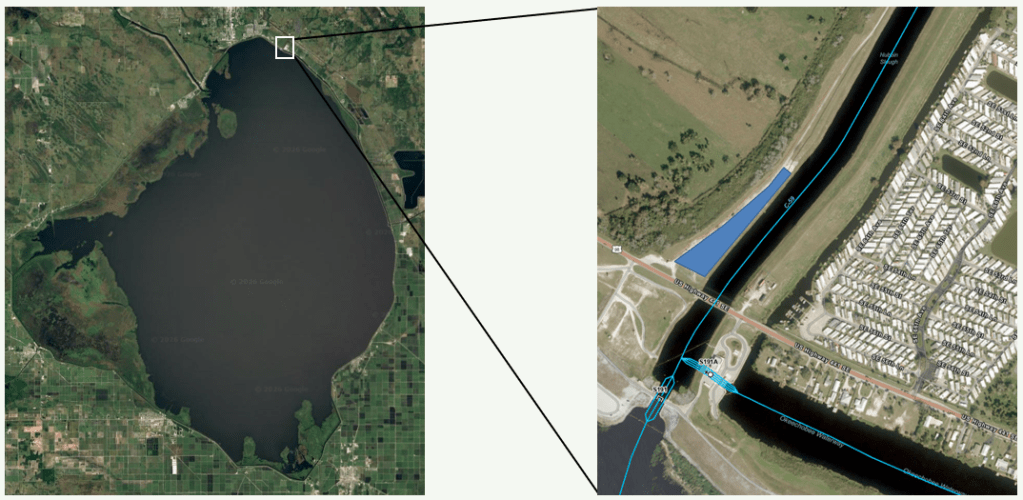
This work will take place at the C-59 canal, right off US Highway 441. The worksite is depicted above as the blue shape in the right image.
-
Work Hours and Project Duration
The duration of this project is three years.
The treatment system will initially be operated on weekdays from 8 AM to 5 PM.
The system will have the capability to operate remotely. Once the treatment process has been optimized, it will operate 7 days per week for 24 hours per day.
Potential Hazards and Safety Measures
Three corrosive chemicals will be stored onsite.
The following safety measures will be implemented to protect the public and the environment:
- The public will not have access to the site.
- Each chemical will have secondary containment, proper labeling, spill kits and SDS onsite.
- Personnel will be trained in spill prevention and emergency procedures, with manuals onsite.

